Light is everything in an image, yet every image sensor built today throws away 70% of the light it receives.
Color imaging has relied on the same fundamental principle for more than half a century. The Bayer color filter array, present in virtually every CMOS image sensor today, covers the sensor with a mosaic of red, green, and blue filters. Each filter lets only one color through and absorbs the rest. This means two thirds of the light never reaches the sensor.
No amount of software, AI, or post-processing can recover what was never captured. This is a structural, persistent penalty that affects the 7 billion cameras sold each year, from smartphones to industrial inspection systems.
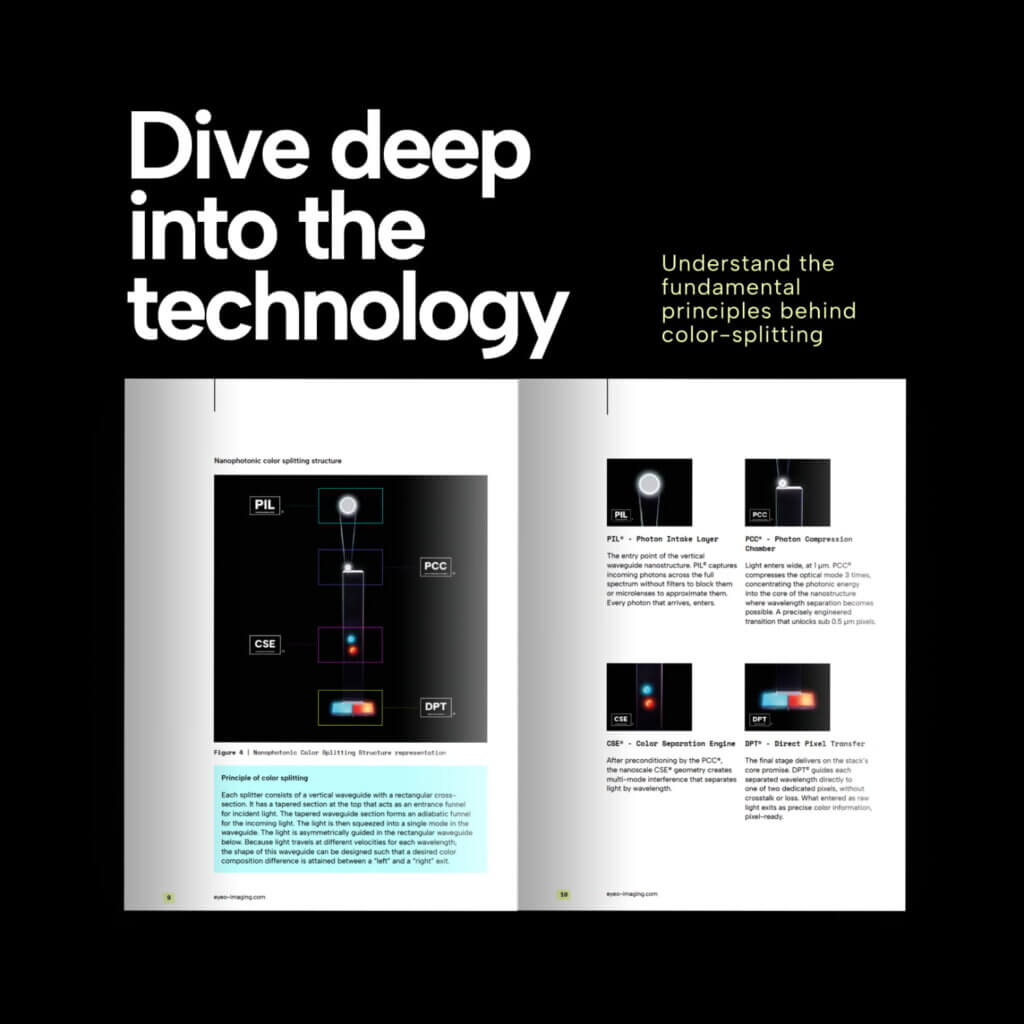
eyeo takes a different approach, rather than filtering light, eyeo splits it. eyeo’s sensors feature NCOS® (Nanophotonic Color Splitting), which includes a layer of precisely engineered nanostructures that split light by wavelength and guide each color directly to the right pixel. No light is absorbed. No color information is discarded. And the architecture works with standard semiconductor manufacturing, making it a practical path to volume production.
Developed over 7 years of research & development at imec, Europe’s leading semiconductor research center, and protected by 26 patents, the result is a new baseline for what image sensors can deliver: 3x more light, within the same physical footprint.
This whitepaper explains the science, the architecture, and the implications, for engineers evaluating new sensors and for product and strategy teams asking what becomes possible when light itself is no longer the constraint.